

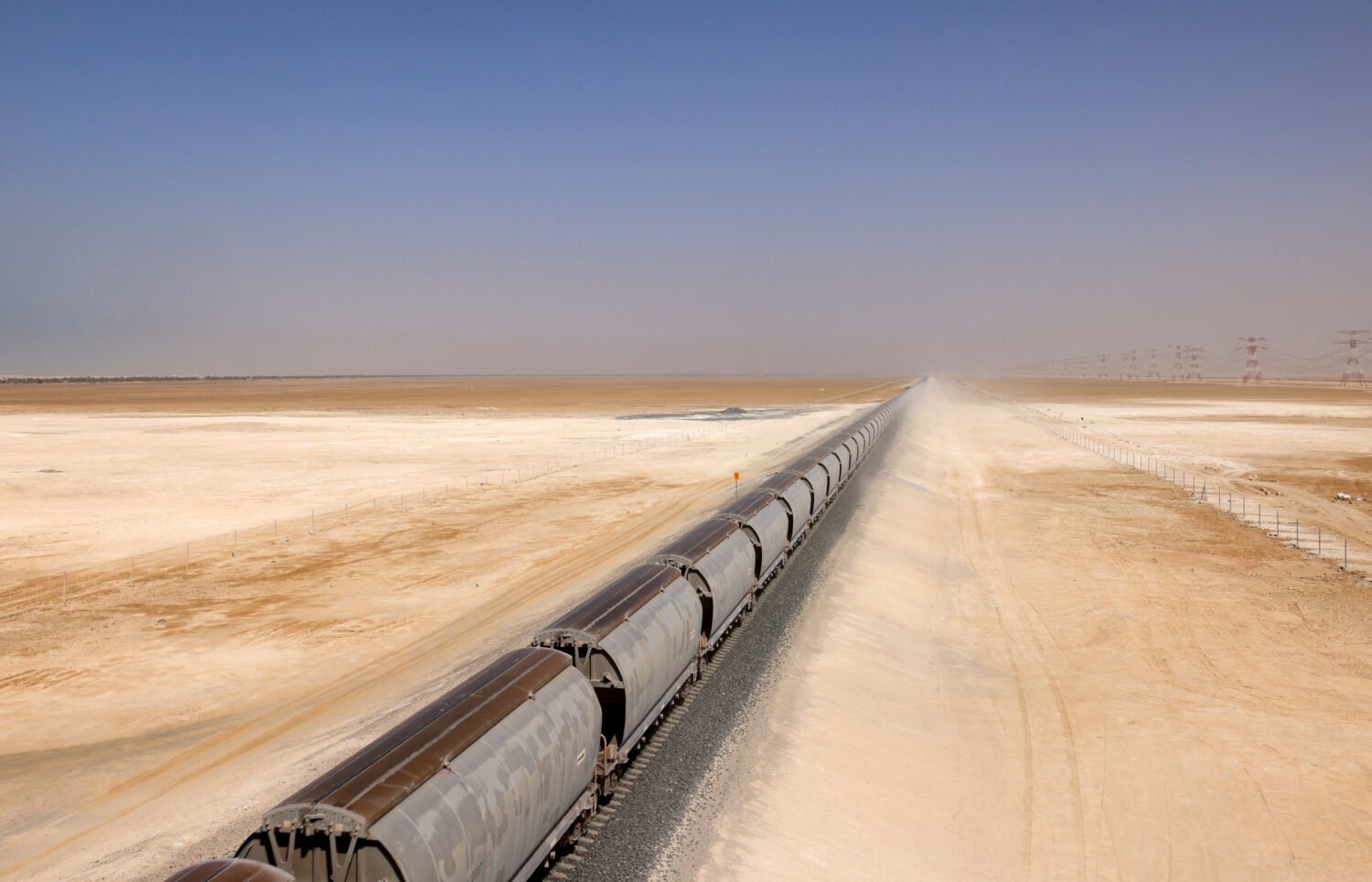
In the weeks since Iran’s closure of the Strait of Hormuz, the Gulf’s commercial response has taken on a markedly infrastructural character. April 2026 alone has seen Saudi Arabia Railways announce five new logistics corridors, a five-year USD 5.44 billion currency swap concluded between the Central Banks of the United Arab Emirates and Bahrain, a Saudi-Qatari memorandum of understanding on maritime and logistics cooperation, and new Dubai-Oman customs facilitation through a designated ‘Green Corridor’. To these should be added the older transregional initiatives now acquiring fresh urgency — the India-Middle East-Europe Economic Corridor, the Iraq Development Road, the Oman-Europe Liquid Hydrogen Corridor, and other emerging Red Sea, Gulf and Eastern Mediterranean connectivity initiatives.
Recent programming by the Arab Center for Research and Policy Studies on Gulf security and regional transformation underscores the growing importance of connectivity, logistics and strategic corridors in the Gulf’s post-crisis policy landscape. Their proliferation is the structural counterpart to the diplomatic crisis our President recently characterised in Al Jazeera, and to the legal architecture surveyed in the Branch’s Tuesday analysis of 21 April. The present piece extends that line of analysis to the law that will govern the corridors themselves. Three strands of law now stand to do so.
The GCC’s regional framework.
The Economic Agreement between the GCC States of 31 December 2001, the Common Customs Law of the GCC States, and the GCC Customs Union implemented from 1 January 2003 together established the Gulf’s core customs-union architecture and common market. Their provisions on national treatment, tariff harmonisation and freedom of movement of goods will be tested, and may in certain respects require refinement, as the new corridor model emerges. The Economic Agreement’s investment-climate provisions, in particular Article 5, provide the parallel framework for cross-border investment in corridor infrastructure, and carry particular salience where those corridors traverse free zones and special economic zones whose own legal regimes must be reconciled with the GCC baseline.
Multilateral discipline.
The WTO Trade Facilitation Agreement of 2013 imposes disciplines on transit formalities, customs cooperation and expedited release — all directly relevant to the GCC’s emerging ‘Green Corridors’ and fast-track arrangements. Participating GCC States are bound accordingly. The multilateral system, even in periods of geopolitical stress, will continue to frame what is permissible.
Transregional instruments.
The India-Middle East-Europe Economic Corridor, the Iraq Development Road and analogous initiatives exist at varying levels of legal formality — some as political declarations, some as framework memoranda, some as the subject of bilateral agreements of increasing specificity. The International Law Association’s Committee on the Rule of Law and International Investment Law, in its Final Report adopted at the Athens Conference in 2024, emphasised the centrality of enforceable legal protections for cross-border investment, particularly where infrastructure projects span multiple jurisdictions. That work is directly germane to the questions before us. Recent work by scholars associated with the College of Law, Hamad Bin Khalifa University, on international economic law, investment regulation and transnational dispute settlement also offers rigorous analytical tools for assessing the legal infrastructure of cross-border corridors.
The Branch has a constructive role to play in clarifying which instruments bind, which merely commit, and where the legal architecture of the corridors requires reinforcement. That task is the subject of the third and concluding piece in this series
References
1. Saudi Arabia Railways, Press Release on the Launch of Five New Logistics Corridors (10 April 2026); Central Bank of the United Arab Emirates and Central Bank of Bahrain, Five-Year USD 5.44 Billion Currency Swap Agreement (signed 8 April 2026); Saudi Ports Authority (Mawani) and Mwani Qatar, Memorandum of Understanding on Maritime and Logistics Cooperation (Riyadh, 17 February 2026); Dubai Customs and Royal Oman Police Customs, Joint Directive on the Oman-Dubai ‘Green Corridor’ (per statement of Abdulla Busenad, Director-General of Dubai Customs, 2026).
2. On the older transregional initiatives: India-Middle East-Europe Economic Corridor (IMEC), launched at the G20 Summit, New Delhi, September 2023; Iraq Development Road, framework agreement signed by Iraq, Türkiye, Qatar and the United Arab Emirates, Baghdad, April 2024; Oman-Europe Liquid Hydrogen Corridor, OQ–Hydrom partnership with the Port of Amsterdam, framework concluded 2025.
3. See Arab Center for Research and Policy Studies, 13th Gulf Studies Forum on Gulf Security and the US-Israel War on Iran (Doha Institute, forthcoming 21–22 November 2026), and related ACRPS situation assessments on regional security and transformation in 2026.
4. Ahmed Essa Al-Sulaiti, ‘Iran’s Closure of the Strait of Hormuz is an International Crisis’ (Al Jazeera, 25 March 2026) https://www.aljazeera.com/opinions/2026/3/25/irans-closure-of-the-strait-of-hormuz-is-an-international-crisis accessed 28 April 2026.
5. International Law Association – GCC Branch, ‘The Legal Architecture of the Hormuz Closure’ (Tuesday Analytical Briefing, 21 April 2026).
6. Economic Agreement between the GCC States (Muscat, 31 December 2001), in particular Article 5 (Investment Climate); Common Customs Law of the GCC States (approved by the GCC Supreme Council, 22nd Session, Muscat, 30–31 December 2001; in force from January 2002); GCC Customs Union (implemented 1 January 2003).
7. World Trade Organization, Agreement on Trade Facilitation (concluded at the Bali Ministerial Conference, 7 December 2013; in force 22 February 2017).