

A Primer for Young Lawyers:
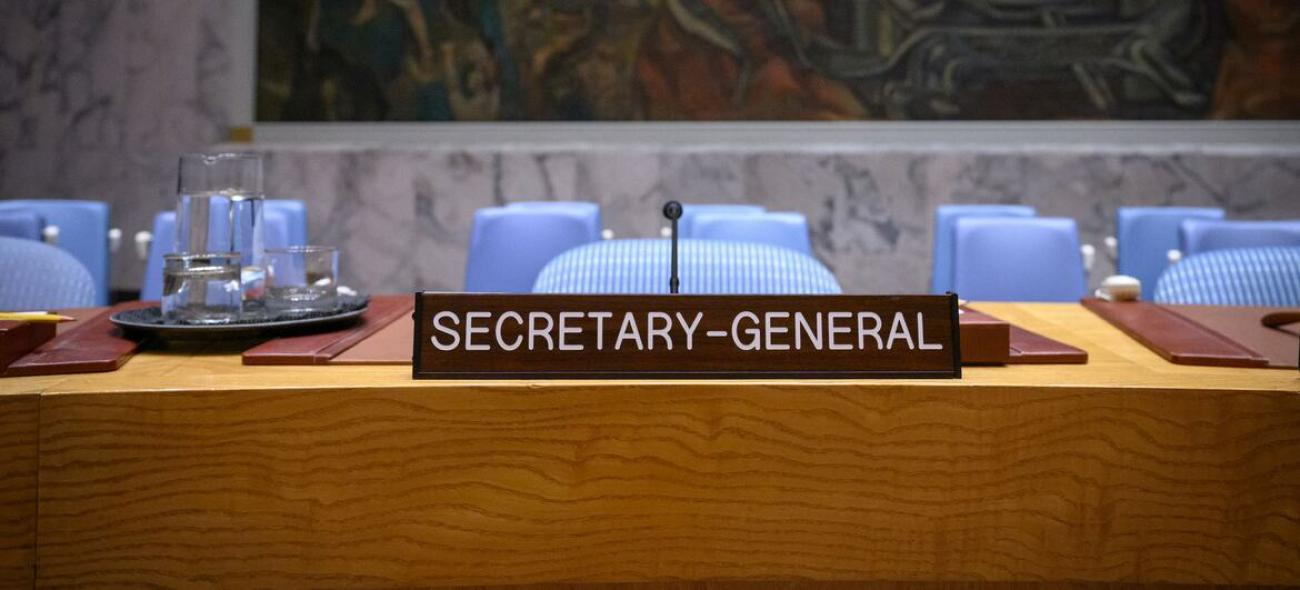
The selection of the United Nations Secretary-General is one of the few multilateral exercises in which Charter law, parliamentary procedure, and political bargaining converge in plain sight. With the second term of HE Mr António Guterres concluding on 31 December 2026, Member States have begun the process of choosing the tenth occupant of that office. For young lawyers in the Gulf region – and across the wider international-law community – the procedure is worth understanding both for its formal architecture and for the recent reforms that have reshaped it.
The Charter rule
Article 97 of the Charter of the United Nations provides that ‘[t]he Secretary-General shall be appointed by the General Assembly upon the recommendation of the Security Council.’¹ That single sentence does considerable work: the General Assembly retains the formal act of appointment, but the Council’s recommendation is, in practice, the decisive moment. By long-standing convention, the Council recommends a single name, which the Assembly then approves – historically by acclamation.
The reform architecture: from 2015 to 2025
For most of the United Nations’ history the selection process was opaque, conducted almost entirely behind the closed doors of the Security Council. That changed in 2015, when the General Assembly adopted Resolution 69/321, introducing the practice of a joint letter from the Presidents of the General Assembly and the Security Council to formally initiate the process, the publication of candidates’ names and vision statements, and public dialogues with candidates.² Resolution 73/341 (2019) consolidated those gains and asked the President of the Assembly to consider further refinements.³
The most consequential recent development is General Assembly Resolution 79/327, adopted on 5 September 2025.⁴ The resolution introduces three notable elements. First, financial transparency: candidates are now expected to disclose, as part of their nomination, the extent and sources of all funding associated with their candidature, addressing concerns from the previous cycle that better-resourced candidates may have enjoyed an undue advantage. Second, a clearer timetable: the selection is to begin ‘in the last quarter of the year preceding the end of the incumbent’s term,’ allowing roughly twelve to fifteen months, depending on when in the final quarter the joint letter is issued. Third, gender: the resolution noted ‘with regret’ that no woman has ever held the office and encouraged Member States ‘to strongly consider nominating women as candidates.’
The 2026 cycle in motion
In line with that timetable, the President of the General Assembly, HE Annalena Baerbock, and the President of the Security Council, HE Michael Imran Kanu, signed and circulated a joint letter on 25 November 2025 inviting Member States to nominate candidates and outlining the principles that would guide the process.⁵ Public Interactive Dialogues with the candidates were held on 21 and 22 April 2026 in the General Assembly hall and broadcast on UN Web TV. Each candidate delivered a ten-minute opening statement based on her or his vision document, followed by questions from Member States and from civil society – a format inherited from the 2016 cycle and now reflected in the reformed selection practice.⁶
What comes next
Attention now shifts to the Security Council. There, the formal recommendation is taken at a private meeting under Rule 48 of the Provisional Rules of Procedure of the Security Council⁷ and is preceded, by long-standing practice since 1991, by a series of secret straw polls in which members signal ‘encourage,’ ‘discourage,’ or ‘no opinion’ on each candidate. Once the Council settles on a single name, the rules of Article 27(3) of the Charter apply: the recommendation requires the affirmative vote of at least nine of the fifteen Council members, including the concurring votes of the five permanent members. A negative vote by any of the P5 – China, France, the Russian Federation, the United Kingdom, or the United States – defeats the candidate.⁸
The Council then transmits a single name to the General Assembly, which appoints the new Secretary-General by resolution. Under standard practice the appointment is made by acclamation; a vote may, however, be taken if requested.
Why this matters for the Gulf
The selection of a new Secretary-General is not a procedural footnote. It is a moment in which all 193 Member States have voice, in which the work of multilateral diplomacy is most visible to the public, and in which the values of the Organisation – peace and security, sustainable development, and human rights – are restated through the choice of its principal officer. For the GCC region, with its growing role as host to United Nations agencies, mediator in regional disputes, and supplier of capable diplomats and lawyers to international institutions, the process repays close study.
Notes
1. Charter of the United Nations (signed 26 June 1945, entered into force 24 October 1945) 1 UNTS XVI, art 97.
2. UNGA Res 69/321 (11 September 2015) UN Doc A/RES/69/321.
3. UNGA Res 73/341 (16 September 2019) UN Doc A/RES/73/341.
4. UNGA Res 79/327 (5 September 2025) UN Doc A/RES/79/327.
5. President of the General Assembly and President of the Security Council, ‘Letter dated 25 6. 6. November 2025 from the President of the General Assembly and the President of the Security Council addressed to all Permanent Representatives and Permanent Observers to the United Nations’ UN Docs A/80/544–S/2025/765.
7. UNSC, Provisional Rules of Procedure (UN Doc S/96/Rev.7, 1983) r 48.
8. Charter of the United Nations, art 27(3).